- Home
- /
- Products
- /
- Alloy Steel
- /
- AISI 4145 45CrMo 1.7223 SCM445 45ХМ 46CrMo4 medium-carbon Cr-Mo alloy steel
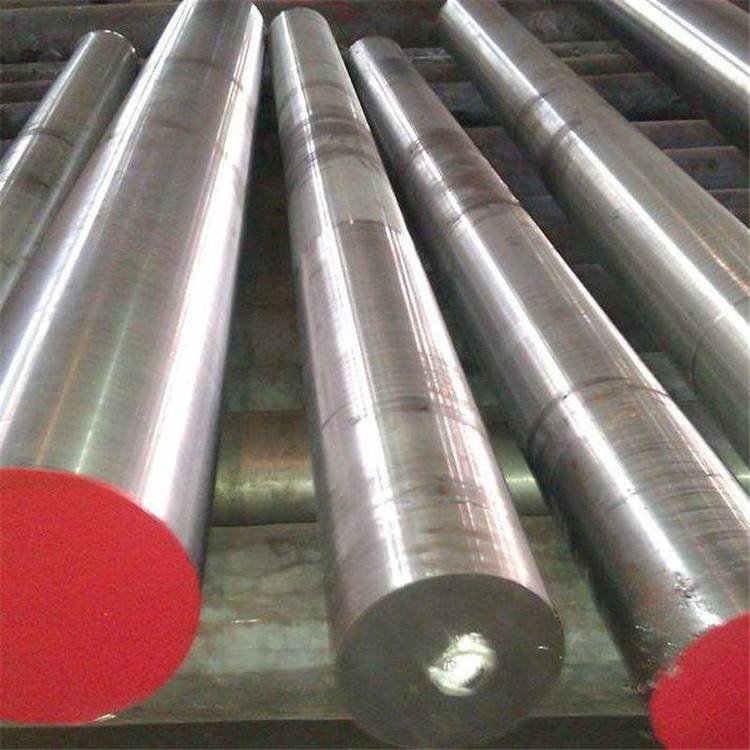
AISI 4145 45CrMo 1.7223 SCM445 45ХМ 46CrMo4 medium-carbon Cr-Mo alloy steel
Details
AISI 4145 is a medium-carbon Cr-Mo alloy steel under SAE J403 standard, upgraded on the basis of 4140 with higher carbon content. It features higher tensile strength, superior surface hardness after quenching and tempering, excellent hardenability and outstanding anti-temper brittleness thanks to chromium and molybdenum composite alloying. Compared with 4140, 4145 delivers stronger wear resistance, while its ductility and impact toughness decrease slightly. It is widely used for heavy-load parts that require ultra-high strength and certain shock resistance, and can be provided as hot-rolled black round bars, precision ground bright bars, forgings and seamless alloy tubes.
Chemical Composition of AISI 4145 (Mass Fraction, wt.%)
| Element | Content Range | Metallurgical Function |
|---|---|---|
| C | 0.43–0.48% | Higher carbon improves matrix hardness, tensile strength and abrasion resistance |
| Si | 0.15–0.35% | Deoxidize molten steel and raise elastic limit of the steel matrix |
| Mn | 0.75–1.00% | Refine internal grains and optimize hardening penetration depth |
| Cr | 0.80–1.10% | Boost hardenability, surface hardness and wear resistance |
| Mo | 0.15–0.25% | Eliminate temper brittleness, maintain high-temperature toughness stability |
| P | ≤0.040% | Harmful impurity limited to avoid cold brittleness under impact load |
| S | ≤0.040% | Strictly controlled to prevent hot cracks during forging and hot processing |
International Equivalent Grades of AISI 4145
| Region & Country | Standard Grade | Material No. & Executive Standard |
|---|---|---|
| USA | AISI 4145, UNS G41450 | ASTM A29 / SAE J403 |
| China | 45CrMo | GB/T 3077 alloy structural steel |
| Europe | 46CrMo4 | 1.7223, EN 10083-1 |
| Japan | SCM445 | JIS G4053 chromium molybdenum steel |
| ISO | 46CrMo4 | ISO 683-1 |
| Russia | 45ХМ | GOST 4543 |
After quenching at 850–880℃ and high-temperature tempering at 500–650℃, AISI 4145 achieves tensile strength above 1100 MPa and surface hardness ranging from HRC 32–48 adjustable by tempering temperature. Surface induction hardening can lift surface hardness to HRC 50–58 for parts with heavy friction. Its deep hardenability enables uniform mechanical properties for thick-section forgings, and it can undergo nitriding treatment to further extend service life under abrasive working conditions.
Its application focuses on heavy-load industrial components. In petroleum machinery, it is the primary material for drill collars, sucker rods, downhole valve bodies and high-pressure wellhead parts enduring underground torsion, friction and impact. In automotive and engineering machinery, it is manufactured into heavy-duty crankshafts, large gear shafts, spline shafts, transmission gears and high-strength bolt sets for loaders and excavators. Besides, it is widely applied for hydraulic cylinder shafts, high-pressure mold frames, heavy forging dies and wind power reducer shafts that demand long service life under continuous alternating loads.
With ultra-high strength, stable heat treatment performance and internationally unified matching grades, AISI 4145 is irreplaceable for high-strength heavy-load components in oil exploration, automobile transmission and construction machinery industries.
Contact us
008617701706555
Room 903, Canyang Zone, No.1016 Youyi Road, Baoshan District, Shanghai, P.R.China
