- Home
- /
- Products
- /
- Alloy Steel
- /
- GCr15 AISI 52100 100Cr6 SUJ2 ШХ15 high-carbon chromium bearing steel spring steel
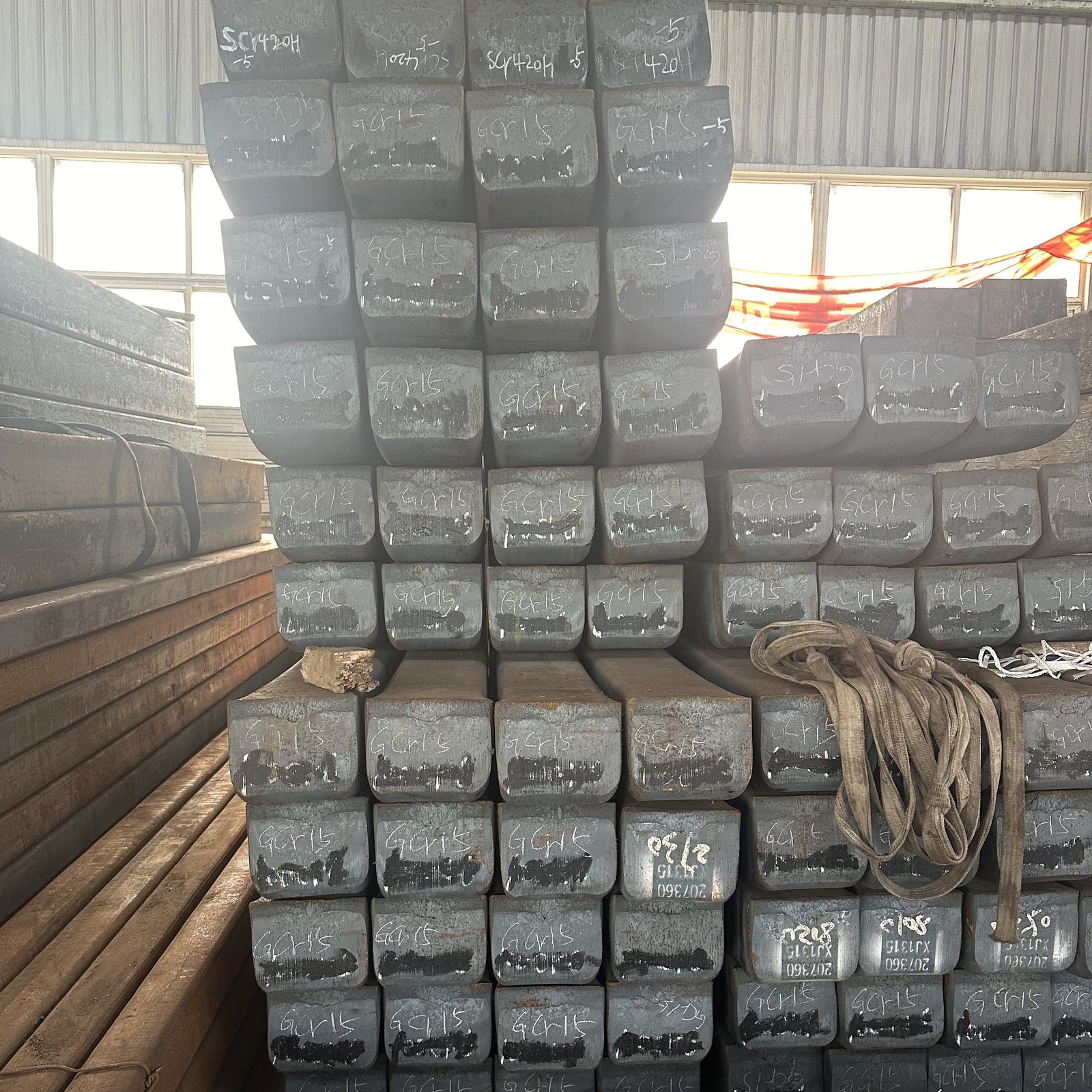
GCr15 AISI 52100 100Cr6 SUJ2 ШХ15 high-carbon chromium bearing steel spring steel
Details
GCr15 is the most widely used high-carbon chromium bearing steel specified by Chinese standard GB/T 18254, recognized globally as the universal raw material for precision rolling bearings. With balanced carbon and chromium alloy design, it delivers ultra-high hardness, outstanding wear resistance, superior rolling contact fatigue strength and stable dimensional consistency after quenching and low-temperature tempering. Spheroidizing annealing greatly optimizes its machinability, while vacuum refining versions feature ultra-low impurities to extend bearing service life. Its only limitation is poor weldability and slight temper brittleness, so welding processes are not recommended for finished bearing parts.
Chemical Composition of GCr15 (Mass Fraction, wt.%)
| Element | Content Range | Core Metallurgical Function |
|---|---|---|
| C | 0.95–1.05% | Provides high matrix hardness and wear resistance |
| Si | 0.15–0.35% | Deoxidizes molten steel, elevates elastic limit |
| Mn | 0.25–0.45% | Refines grain, improves hardenability and toughness |
| Cr | 1.30–1.65% | Key alloy element; forms fine hard carbides, boosts fatigue resistance |
| P | ≤0.025% | Strictly controlled impurity to avoid cold brittleness |
| S | ≤0.025% | Limited to eliminate hot cracking during forging |
| Cu/Ni | ≤0.25% / ≤0.30% | Restrict residual trace elements to stabilize heat treatment performance |
International Equivalent Grades of GCr15
| Region | Standard Grade | Material No. & Executive Standard |
|---|---|---|
| China | GCr15 | GB/T 18254 |
| USA | AISI 52100 (UNS G52986) | ASTM A29 / A485 |
| Europe/Germany | 100Cr6 | W.Nr 1.3505, EN ISO 683-17 |
| Japan | SUJ2 | JIS G4805 bearing steel standard |
| ISO | 100Cr6 | ISO 683-17 |
| Russia | ШХ15 | GOST 801-78 |
After standard heat treatment (oil quenching at 830–860℃ + low-temperature tempering at 150–180℃), GCr15 reaches uniform hardness of HRC 61–66. It can be supplied in multiple forms: hot rolled black skin round bars, precision ground bright bars, wire rods, steel plates and forged blanks, fully matching mass production lines of bearing manufacturers worldwide.
Its application covers four core industrial sectors. First, bearing manufacturing (primary usage): inner/outer rings, steel balls, cylindrical and tapered rollers for deep groove bearings, wheel hub bearings and gearbox bearings, which bear cyclic contact loads at high rotating speeds. Second, automotive industry: engine transmission bearings, steering pin sleeves, and wear-resistant small shafts for new energy vehicle motors. Third, general precision machinery: CNC ball screws, machine tool spindles, measuring tools, cold extrusion dies and high-precision wear sleeves. Fourth, wind power & rail transit: reducer bearings for wind turbine gearboxes and axle bearings for high-speed trains and heavy freight locomotives, requiring ultra-long fatigue life under heavy continuous loads.
With mature production technology, stable mechanical performance and internationally interchangeable equivalent grades, GCr15 dominates the global medium-and-small bearing raw material market and remains the preferred bearing steel for mass manufacturing of high-precision rotating components.
Contact us
008617701706555
Room 903, Canyang Zone, No.1016 Youyi Road, Baoshan District, Shanghai, P.R.China
