- Home
- /
- Products
- /
- Alloy Steel
- /
- 55Si2Mn AISI9255 SUP6 medium-carbon alloy spring steel
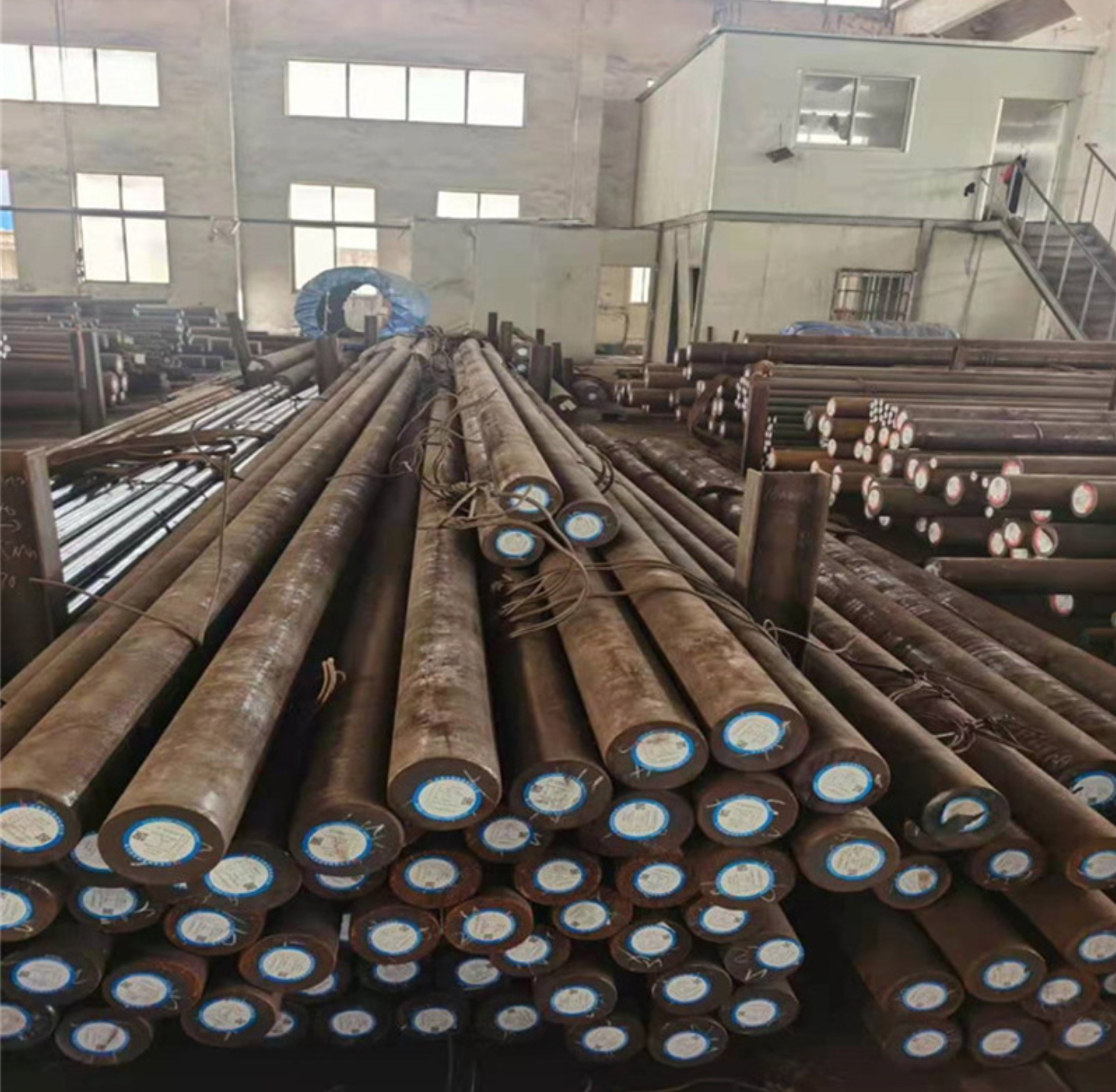
55Si2Mn AISI9255 SUP6 medium-carbon alloy spring steel
Details
55Si2Mn is a classic medium-carbon silicon-manganese alloy spring steel formulated under Chinese standard GB/T 1222. Doped with high silicon and moderate manganese, it features outstanding elastic limit, yield ratio, hardenability, anti-tempering stability and anti-relaxation performance, far superior to ordinary carbon spring steel. Its overheating sensitivity is low, while the only disadvantage is obvious decarburization tendency during high-temperature forging and heat treatment. After quenching and tempering, it obtains matched high strength, fatigue resistance and certain toughness, making it the mainstream material for heavy-load elastic components in transportation and general machinery worldwide.
Chemical Composition of 55Si2Mn (Mass Fraction, wt.%)
| Element | Content Range | Metallurgical Function |
|---|---|---|
| C | 0.52–0.60% | Boosts matrix hardness, tensile strength and fatigue resistance |
| Si | 1.50–2.00% | Core alloy element, greatly raises elastic limit and anti-relaxation capacity |
| Mn | 0.60–0.90% | Refines grain, improves hardenability and impact toughness |
| P | ≤0.035% | Harmful impurity, controlled strictly to avoid cold brittleness |
| S | ≤0.035% | Restricted to prevent hot brittleness during hot working |
| Cr / Ni | ≤0.35% each | Residual trace elements, no intentional addition |
| Cu | ≤0.25% | Impurity limit to eliminate surface crack risk |
International Equivalent Grades of 55Si2Mn
| Region | Standard Grade | Material No. & Standard Code |
|---|---|---|
| China | 55Si2Mn | GB/T 1222 |
| USA | AISI 9255 / UNS G92550 | ASTM A401, SAE J403 |
| Europe/Germany | 55Si7 | W.Nr 1.0904, EN 10089 |
| Japan | JIS SUP6 | JIS G4801 |
| Russia | GOST 55C2 | GOST 14959 |
| ISO | 56Si7 | ISO 683-14 |
After standard heat treatment (quenching at 860–880℃, tempering at 400–450℃), 55Si2Mn reaches tensile strength above 1274 MPa, yield strength over 1176 MPa, and surface hardness of 42–48 HRC. It maintains stable elastic performance under long-term alternating cyclic loads and can work continuously under 250℃ without corrosive medium, suitable for medium-temperature spring parts.
Its application covers three major industries. First, vehicle transportation: leaf springs and large coil springs for trucks, tractors, locomotives and passenger cars, which bear heavy vibration and shock loads in suspension systems. Second, industrial machinery: safety valve springs, check valve springs, pantograph hook springs for power equipment, and various heavy-duty compression and torsion springs for machine tools. Third, special high-temperature elastic parts: heat-resistant springs used below 250℃, buffer springs for mining machinery, and thick wire spring components for agricultural equipment.
Compared with higher-carbon 60Si2Mn, 55Si2Mn owns better ductility and lower cracking risk during forming. With stable supply, mature processing technology and balanced cost-performance, it remains the preferred silicon-manganese spring steel for mass production of heavy-load elastic parts in global machinery and automotive industries.
Contact us
008617701706555
Room 903, Canyang Zone, No.1016 Youyi Road, Baoshan District, Shanghai, P.R.China
