- Home
- /
- Products
- /
- Mold Steel
- /
- H13 4Cr5MoSiV1 hot work tool steel 1.2345 X40CrMoV51
H13 4Cr5MoSiV1 hot work tool steel 1.2345 X40CrMoV51
Details
AISI H13, designated as 4Cr5MoSiV1 under Chinese GB/T 1299 standard, is the most widely used air-hardening Cr-Mo-V worldwide. It features outstanding thermal fatigue resistance, high-temperature toughness, hot hardness and deep hardenability. Unlike water-quenched steels, it adopts air cooling after heating, effectively reducing deformation and cracking risk for large mold blocks. After quenching and tempering, it maintains stable hardness under repeated cold-heat cycles, and it is suitable for nitriding and surface coating to extend service life, making it a universal core material for high-temperature forming tooling.
Table 1: Chemical Composition of H13 (Mass Fraction, wt.%)
表格
| Element | Content Range | Core Metallurgical Function |
|---|---|---|
| C | 0.32–0.45% | Balances matrix hardness and impact toughness, avoids over-brittle structure |
| Si | 0.80–1.20% | Improves high-temperature oxidation resistance and deoxidizes molten steel |
| Mn | 0.20–0.50% | Refines grain and optimizes machinability under annealed state |
| Cr | 4.75–5.50% | Core alloy element; boosts hardenability, wear resistance and anti-heat-checking performance |
| Mo | 1.10–1.75% | Suppresses temper brittleness, retains strength at 500–600℃ working temperature |
| V | 0.80–1.20% | Forms fine hard carbides, refines grain and greatly elevates high-temperature abrasion resistance |
| P | ≤0.030% | Harmful impurity limited to eliminate cold brittleness |
| S | ≤0.030% | Strictly controlled to prevent hot cracking during forging and molding |
Table 2: International Equivalent Grades of H13
表格
| Region | Standard Grade | Material No. & Executive Standard |
|---|---|---|
| China | 4Cr5MoSiV1 | GB/T 1299 |
| United States | AISI H13 (T20813) | ASTM A681 |
| Europe/Germany | X40CrMoV5-1 | 1.2345, EN 10083-3 |
| Japan | SKD61 | JIS G4404 |
| ISO | X40CrMoV51 | ISO 4957 |
| UK | BH13 | BS EN Standard |
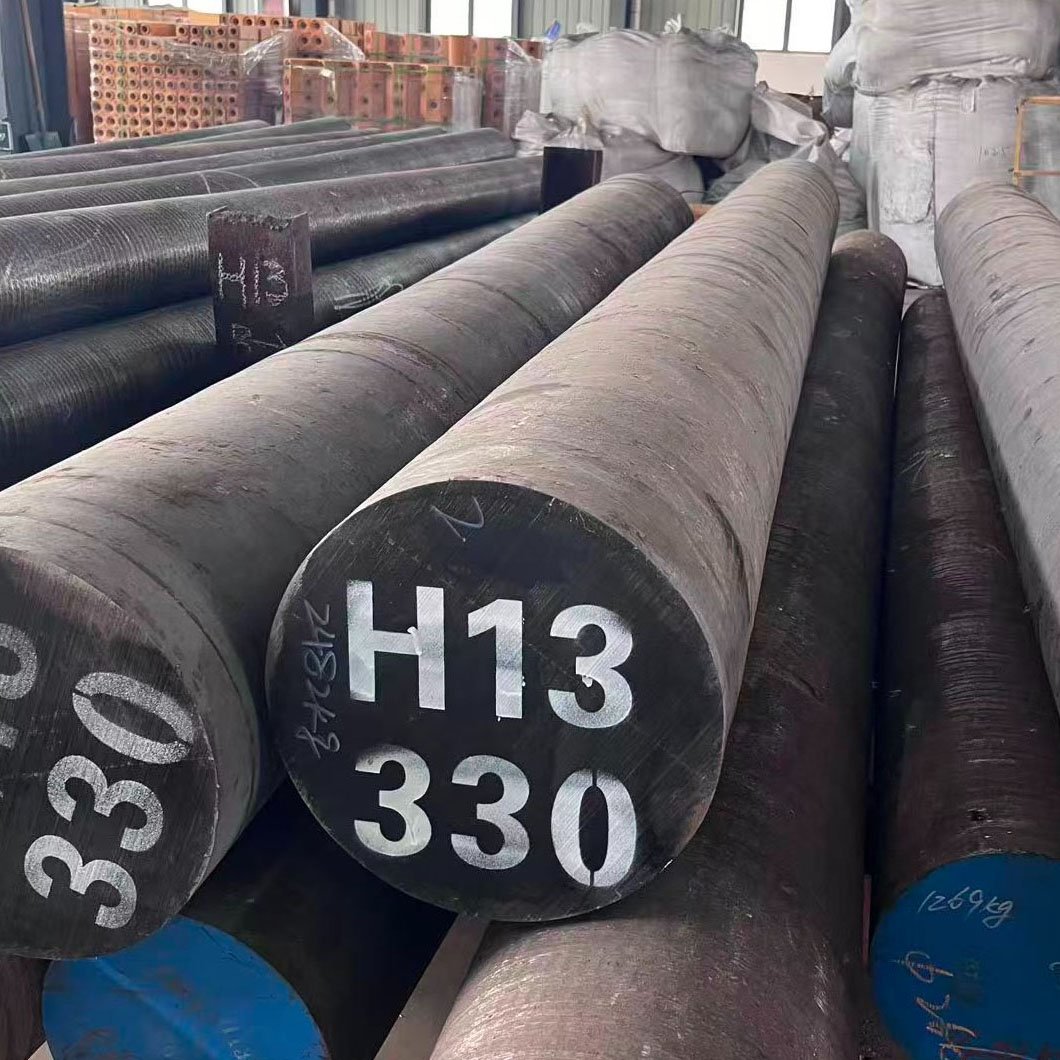
After standard heat treatment (air quenching at 1020–1050℃, double tempering at 500–580℃), H13 reaches hardness of 48–54 HRC with excellent toughness. Its unique alloy formula resists heat checking (surface crack) caused by rapid temperature alternation, the most common failure of hot molds. It can be supplied in multiple forms: hot-rolled black skin round bars, forged mold blocks, flat plates and precision ground bright bars.
Its application covers three major high-temperature processing industries. First, aluminum/magnesium/zinc die casting industry: main mold cavities, core pins, slides, ejector sleeves and die holders for auto engine parts, 3C electronic shells and household appliance castings. Second, metal hot extrusion field: extrusion dies, mandrels and liners for aluminum alloy profiles, copper tubes and brass fittings. Third, hot forging & stamping sector: hot forging dies, press inserts, hot shear blades and punch tools for automotive crankshafts, gears and hardware forgings. It is also used for plastic hot injection molds, high-pressure valve cores and wear-resistant mechanical parts requiring high-temperature stability.
With stable comprehensive performance, mature heat treatment technology and globally unified equivalent grades, H13 dominates the hot work mold steel market and is the preferred material for mass production high-temperature tooling across automotive, machinery and non-ferrous metal processing industries.
Contact us
008617701706555
Room 903, Canyang Zone, No.1016 Youyi Road, Baoshan District, Shanghai, P.R.China
