- Home
- /
- Industry information
- /
- Processing Procedure and Precautions for Ejector Pins Made of H13 Wire Rod
Processing Procedure and Precautions for Ejector Pins Made of H13 Wire Rod
Ejector pins are core components of injection and die-casting molds, generally manufactured from hot work tool steel like H13.
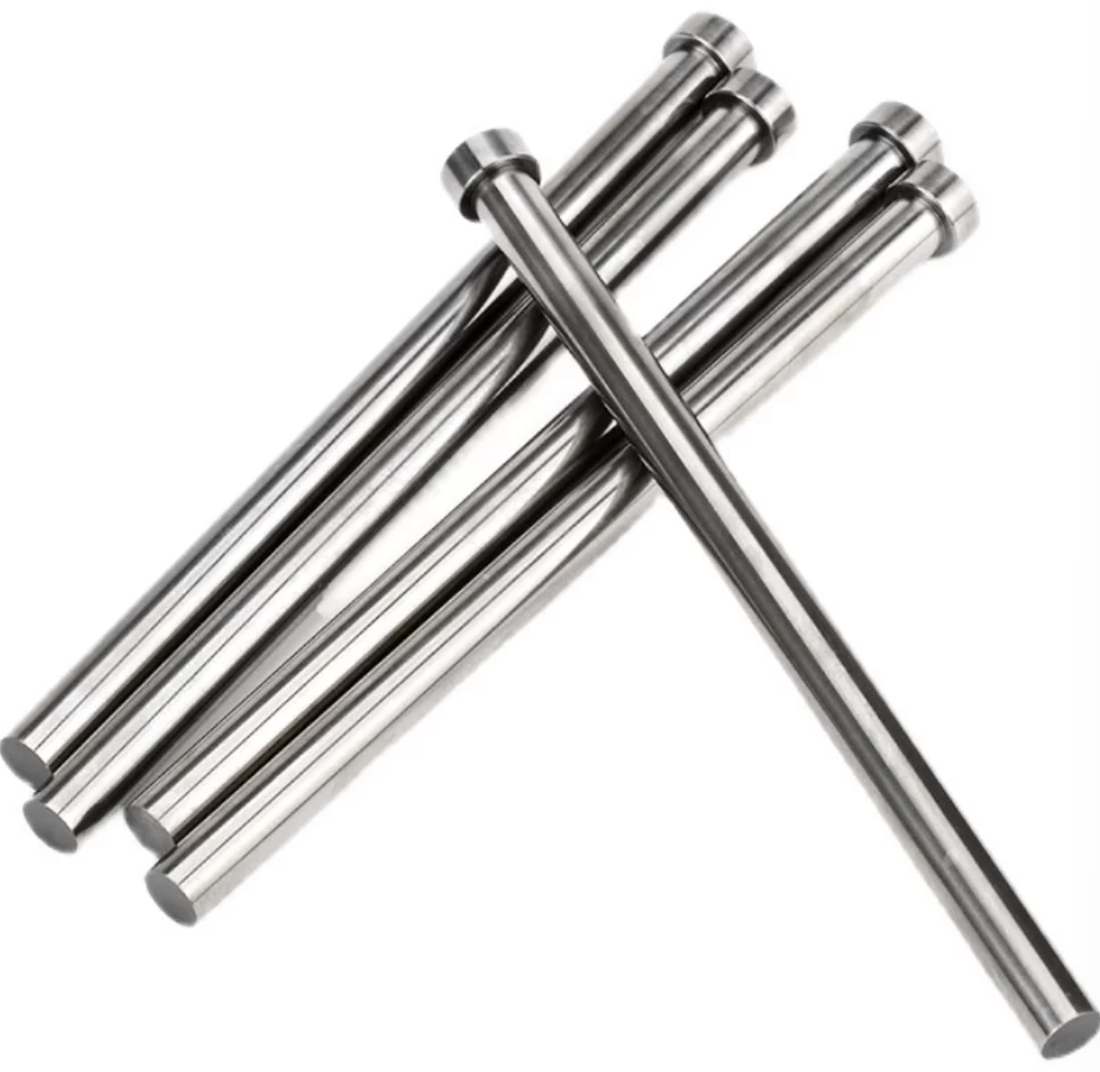
- Eject finished productsAfter molten plastic or alloy solidifies, ejector pins move forward together with the ejector plate to push molded parts out of the mold cavity smoothly, realizing automatic demolding and continuous mold cycling.
- Auxiliary air ventingTiny clearances between ejector pins and mold cores discharge trapped air during filling, preventing product defects such as air bubbles, burning and short shots.
- Form tiny product featuresSmall-diameter ejector pins can directly form micro holes, protrusions and tiny boss logos on parts, simplifying mold insert design.
Uniform ejection force distributionMulti-point layout of ejector pins disperses ejection pressure, avoiding whitening, cracking or deformation of thin-walled and slender plastic components.
2. Main Materials for Ejector Pins
1. Hot Work Tool Steel (Most widely used for injection & die casting molds)
- H13 (4Cr5MoSiV1): Universal grade with excellent heat resistance and toughness, ideal for plastic injection and aluminum die casting ejector pins, suitable for nitriding treatment.
- SKD61: Japanese equivalent of H13, superior polishing performance for mirror surface molds.
- 8407 (1.2344): High-purity hot work steel for long-service precision ejector pins.
2. Cold Work Tool Steel (High-wear plastic filled with glass fiber)
- SKD11 / D2 (1.2379): Extremely high hardness and wear resistance, for glass-filled or carbon-filled plastics; relatively brittle for slender pins.
- Cr12MoV: Domestic low-cost cold work steel for low-end wear-resistant ejectors.
3. High Speed Steel (HSS, for high-fiber & high-temperature engineering plastics)
- SKH-51 / M2: Good red hardness and wear resistance, for PPS, LCP and heavily glass-reinforced materials, hardness up to 60–64 HRC.
- PM Powder Metallurgy HSS (PM23, ASP23): Fine grain structure balancing wear resistance and toughness for high-end precision pins.
4. Carbon & Bearing Steel (Low-demand temporary molds)
- SUJ2 (GCr15 bearing steel): Low cost, only for simple low-temperature plastic molds, poor heat resistance.
- S45C / 45# steel: For trial molds with short production cycles.
5. Special Materials
- Beryllium Copper: Outstanding thermal conductivity, used as heat-dissipating ejectors to eliminate sink marks and air bubbles.
- Tungsten Carbide: Ultra-high wear resistance for micro tiny ejector pins, high brittleness and high cost.
3. H13 Complete Processing Flow
- Material Preparation & Cutting: Use annealed H13 wire rod with hardness ≤235HB. Cut blanks according to the overall length of ejector pins, grind flat end faces to remove burrs and surface oxide scales, so as to avoid tool scratches during turning.
- CNC Rough & Finish Turning: Perform rough turning of shanks, steps and heads via sliding head lathes, leaving 0.08–0.12 mm grinding allowance. Finish turning ensures coaxiality, and all sharp corners are rounded to R0.3 to reduce stress concentration in heat treatment. Adopt TiAlN coated carbide cutters with sufficient cutting fluid for cooling to prevent tool burning.
- Stress Relief Annealing: Keep workpieces at 740°C for 2 hours and cool down slowly with furnace to eliminate machining stress and severe bending deformation after heat treatment.
- Quenching & Tempering: Conduct gas/oil quenching at 1020–1050°C, and temper immediately when cooled below 100°C. Double temper at 560°C to achieve finished hardness of 48–52 HRC, balancing wear resistance and impact toughness. Slender ejector pins shall be vertically clamped during heating to control bending.
- Precision Cylindrical Grinding: Grind shanks after heat treatment with dimensional tolerance ±0.005 mm and surface roughness Ra ≤0.2 μm, ensuring smooth sliding without mold cavity scratching.
- Optional Surface Strengthening: Plasma nitriding at 510°C for 6–10 hours to form 0.1–0.2 mm penetration layer for high-temperature wear and anti-seizure performance. Reserve 0.02–0.04 mm allowance before nitriding and finish light polishing afterwards.
- Final Inspection & Sorting: Check straightness, hardness, outer diameter and surface defects, reject products with bending, cracks or out-of-tolerance dimensions.
4. Key Precautions
- Machining Control: H13 contains hard vanadium carbides which wear tools rapidly. Dry cutting at high rotation speed is forbidden. Reduce feed rate and add center support for slender pins to avoid chatter and taper tolerance failure.
- Anti-deformation & Anti-cracking in Heat Treatment: Do not cool to room temperature before tempering; fully cool workpieces between two tempering cycles. Pins with length-diameter ratio over 10:1 cannot be laid flat during heating to prevent bending. Sharp edges without radians easily crack after nitriding and break during service.
- Grinding Requirements: Use corundum wheel at low speed with continuous cooling when grinding hardened blanks, to avoid grinding annealing and surface microcracks.
- Service Adaptation: Hardness shall not exceed 52 HRC, otherwise high brittleness leads to frequent breakage under repeated high-temperature ejection in injection molding. Excessively thick nitrided layer causes peeling and mold scratching.
Contact us
008617701706555
Room 903, Canyang Zone, No.1016 Youyi Road, Baoshan District, Shanghai, P.R.China
