- Home
- /
- Products
- /
- Billet
- /
- H13 forged billet hot work die steel 4Cr5MoSiV1 X40CrMoV5-1 X40CrMoV51 1.2345
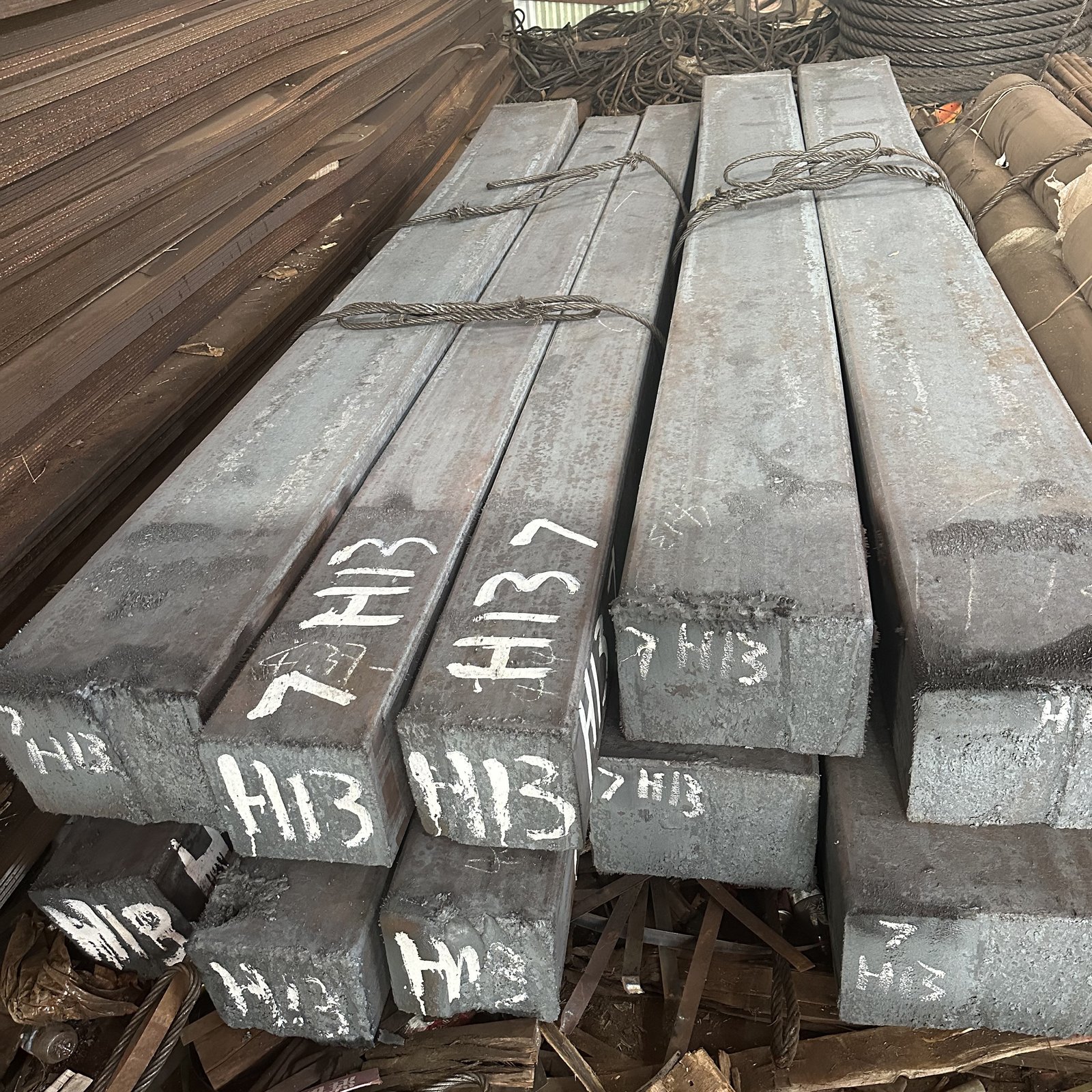
H13 forged billet hot work die steel 4Cr5MoSiV1 X40CrMoV5-1 X40CrMoV51 1.2345
Details
H13 (4Cr5MoSiV1) forged billet, corresponding to European grade X40CrMoV5-1 (1.2345) and Japanese SKD61, is a core semi-finished blank of air-hardening hot work die steel produced through electric furnace smelting, ESR refining, large forging and full annealing. Compared with ordinary hot rolled round bars, forged H13 billets own denser internal microstructure, fewer segregation and shrinkage defects, uniform carbide distribution and outstanding overall isotropy, making them the preferred raw material for large-size hot forging dies, die casting mold bases and heavy hot extrusion tooling.
Table 1: Chemical Composition of H13 Billet (Mass Fraction, wt.%)
表格
| Element | Content Range | Metallurgical Function |
|---|---|---|
| C | 0.32–0.45% | Balance matrix hardness and impact toughness, avoid excessive brittleness |
| Si | 0.80–1.20% | Improve high-temperature oxidation resistance and deoxidize molten steel |
| Mn | 0.20–0.50% | Refine grains and promote easy machining under annealed state |
| Cr | 4.75–5.50% | Core alloy element for hardenability, heat check resistance and wear resistance |
| Mo | 1.10–1.75% | Suppress temper brittleness, retain stable strength under high temperature |
| V | 0.80–1.20% | Form fine hard carbides, boost thermal fatigue and abrasion resistance |
| P | ≤0.030% | Strict impurity control to prevent cold brittleness |
| S | ≤0.030% | Limit hot cracking risk during forging and mold processing |
Table 2: International Equivalent Grades of H13 Billet
表格
| Region | Standard Grade | Material No. & Standard |
|---|---|---|
| China | 4Cr5MoSiV1 (H13) | GB/T 1299 |
| USA | AISI H13, UNS T20813 | ASTM A681 |
| EU | X40CrMoV5-1 | 1.2345, EN 10083-3 |
| Japan | SKD61 | JIS G4404 |
| ISO | X40CrMoV51 | ISO 4957 |
H13 forged billets undergo multi-directional heavy forging to break coarse cast dendrite structures, eliminate internal porosity and looseness. After full spheroidizing annealing, the hardness drops to HB 180–230, allowing smooth sawing, rough milling and CNC rough machining without tool overload. Standard heat treatment for finished molds: air quenching at 1020–1050℃ plus double tempering at 500–580℃, achieving hardness HRC 48–54 with excellent thermal fatigue resistance to resist thermal cracks caused by repeated cold-hot alternation during die casting and hot forging.
The main application scenarios of H13 billets focus on heavy high-temperature forming tooling. First, aluminum/zinc alloy die casting industry: large integral mold bases, cavity inserts, slide blocks and ejector sleeves for auto structural parts, new energy vehicle housing and 3C electronic casings. Second, metal hot extrusion field: heavy extrusion cylinders, mandrels and dies for aluminum profiles, copper pipes and brass fittings. Third, hot forging industry: large hot forging mold blanks for crankshafts, gears, connecting rods and heavy hardware forgings. It also serves as blank for high-temperature hot stamping punches, plastic hot injection molds and high-pressure valve molds.
Forged H13 billets can be customized into square, rectangular and round blocks with various dimensions. With ultra-low internal defects, stable heat treatment performance and long mold service life, ESR refined H13 billets are widely supplied to mold factories, die casting manufacturers and hot forging enterprises all over the world.
Contact us
008617701706555
Room 903, Canyang Zone, No.1016 Youyi Road, Baoshan District, Shanghai, P.R.China
