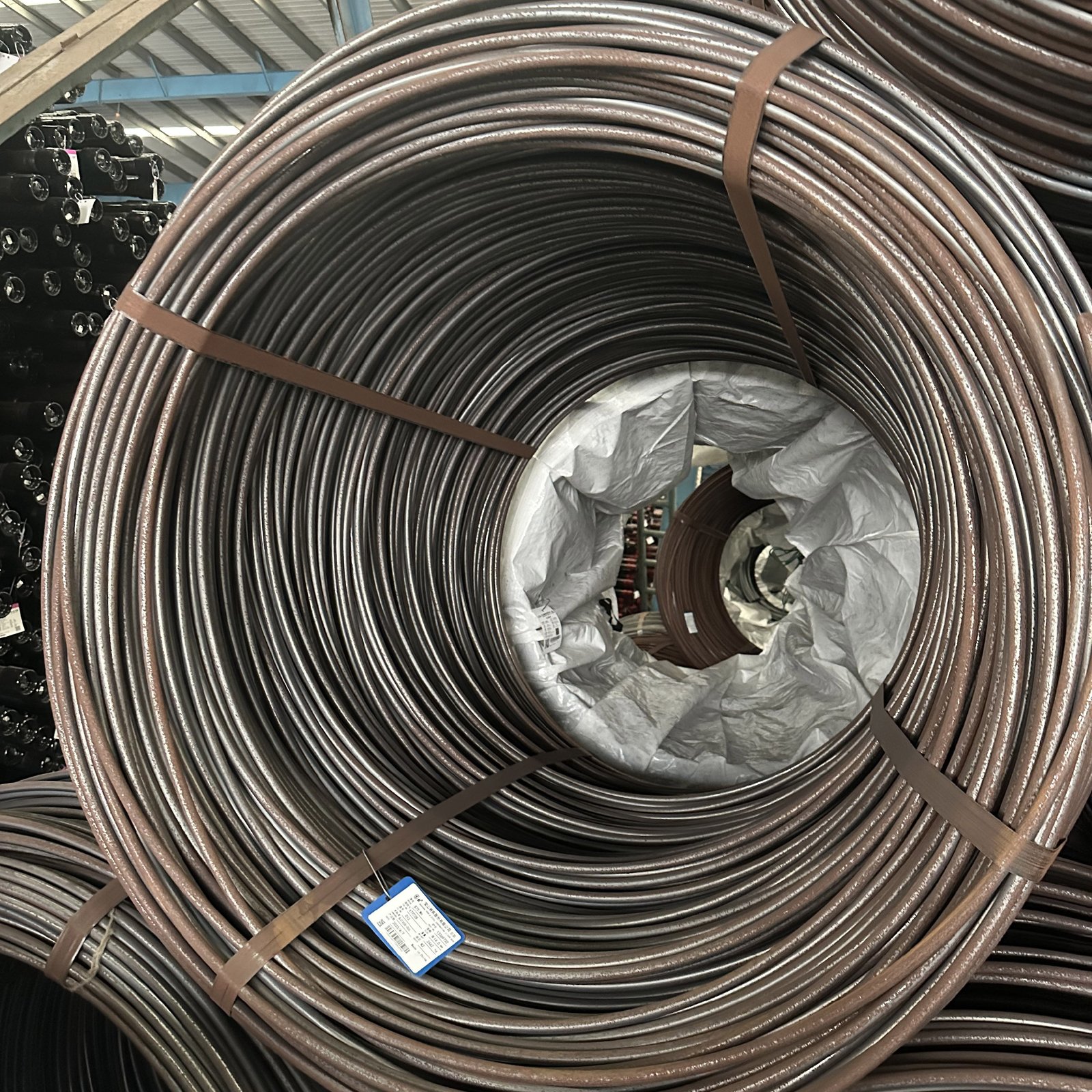
10B21 cold-heading wire rod SWRCHB22K fastener fine drawn wire
Details
10B21 is classic cold-heading quality (CHQ) low-carbon boron steel wire rod formulated under SAE J403 and ASTM A1040 standards, widely recognized as the most cost-effective raw material for medium-high strength fasteners globally. The trace boron element is its core feature; even a tiny boron content dramatically improves hardenability without raising carbon content, delivering excellent cold forming plasticity and stable heat treatment response. Compared with ordinary 1021 carbon steel, 10B21 avoids cracking during cold extrusion and heading, while reaching higher tensile strength after quenching & tempering. It can be supplied as hot rolled black wire rod, spheroidizing annealed wire, or phosphating coated fine drawn wire, perfectly matching mass fastener production lines.
Chemical Composition of 10B21 (Mass Fraction, wt.%)
| Element | Content Range | Metallurgical Function |
|---|---|---|
| C | 0.18–0.23% | Controls base strength, guarantees good cold ductility |
| Si | ≤0.10% | Low silicon design to reduce decarburization risk |
| Mn | 0.70–1.00% | Refines grain, enhances toughness and hardening performance |
| B | 0.0008–0.0035% | Key alloy element, greatly boosts deep hardenability |
| P | ≤0.020% | Strict impurity limit to prevent cold brittleness |
| S | ≤0.020% | Controlled to eliminate hot cracking during forging |
| Cr/Ni/Cu | ≤0.20% each | Restrict residual trace elements for stable forming |
International Equivalent Grades of 10B21
| Region | Standard Grade | Executive Standard |
|---|---|---|
| USA | SAE 10B21, UNS G10211 | SAE J403, ASTM A1040 |
| China | 20MnB (approximate equivalent) | Q/BQB 517-2023, GB/T 3077 |
| Japan | SWRCHB22K | JIS G3507 cold heading wire rod |
| ISO | C20B | ISO 4954 wire rod for cold forming |
| Europe | 18B2 | EN 10263 boron cold forming steel |
Under standard heat treatment (870–900℃ quenching + 420–460℃ tempering), 10B21 fasteners achieve mechanical properties up to Class 8.8 and 9.8 per GB/T 3098.1; nuts made from this material can reach Grade 10. Its low carbon feature ensures outstanding weldability, and spheroidizing annealing further optimizes surface ductility for complex shaped cold forged parts. The raw wire rod has uniform internal microstructure, low inclusion content and smooth surface, cutting die wear during mass production.
Its application covers three major downstream industries. First, automotive fastener manufacturing: engine bolts, chassis studs, wheel nuts, suspension screws and vehicle assembly connecting parts, which demand balanced strength and fatigue resistance. Second, general machinery & hardware: high-strength bolts, self-tapping screws, rivets and small cold extruded structural components for pumps, motors and equipment frames. Third, electronics & construction: precision fasteners for household appliances, solar bracket bolts, and standard construction fasteners with moderate load bearing.
With low raw material cost, mature processing technology and unified cross-border equivalent grades, 10B21 wire rod dominates the global fastener raw material market and is the universal choice for mass production of Class 4.8–9.8 fasteners.
Contact us
008617701706555
Room 903, Canyang Zone, No.1016 Youyi Road, Baoshan District, Shanghai, P.R.China
